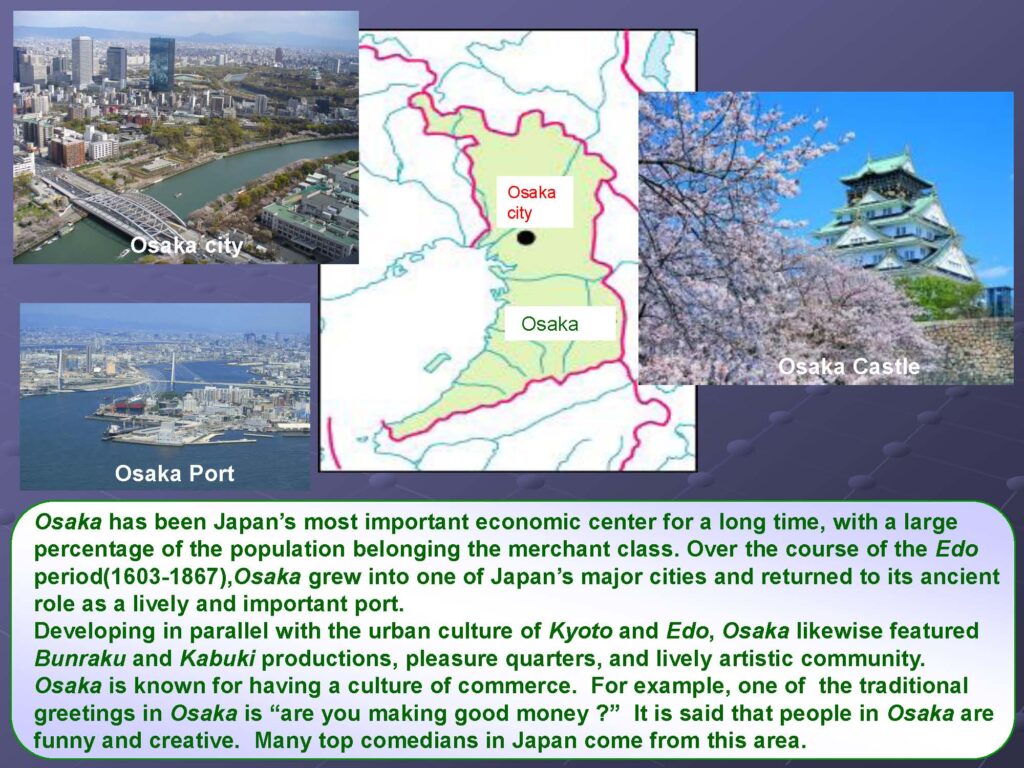
Osaka is a designated city in the Kansai region of Honshu, Japan. It holds a significant place in Japan’s history, culture, and economy. Here are some key points about Osaka:
- Historical Significance:
- Ancient Roots: Archaeological evidence suggests human settlement in the Osaka area during the Paleolithic period.
- Imperial Capital: In the 7th and 8th centuries, Osaka briefly served as the imperial capital.
- Edo Period: During the Edo period (1603–1867), Osaka continued to flourish and became known as a center of Japanese culture.
- Economic Hub:
- Traditionally, Osaka was considered Japan’s economic hub.
- Industrialization: Following the Meiji Restoration, Osaka rapidly expanded and underwent industrialization.
- Financial Center: Today, Osaka is a major financial center in Japan.
- Population and Multiculturalism:
- With a population of 2.7 million in the 2020 census, Osaka is the third-most populous city in Japan.
- It is the largest component of the Keihanshin Metropolitan Area, which has over 19 million inhabitants.
- Osaka is recognized as one of the most multicultural and cosmopolitan cities in Japan.
- Business and Research:
- Osaka hosts the Osaka Exchange and is home to multinational electronics corporations like Panasonic and Sharp.
- It is an international center of research and development with major universities such as Osaka University.