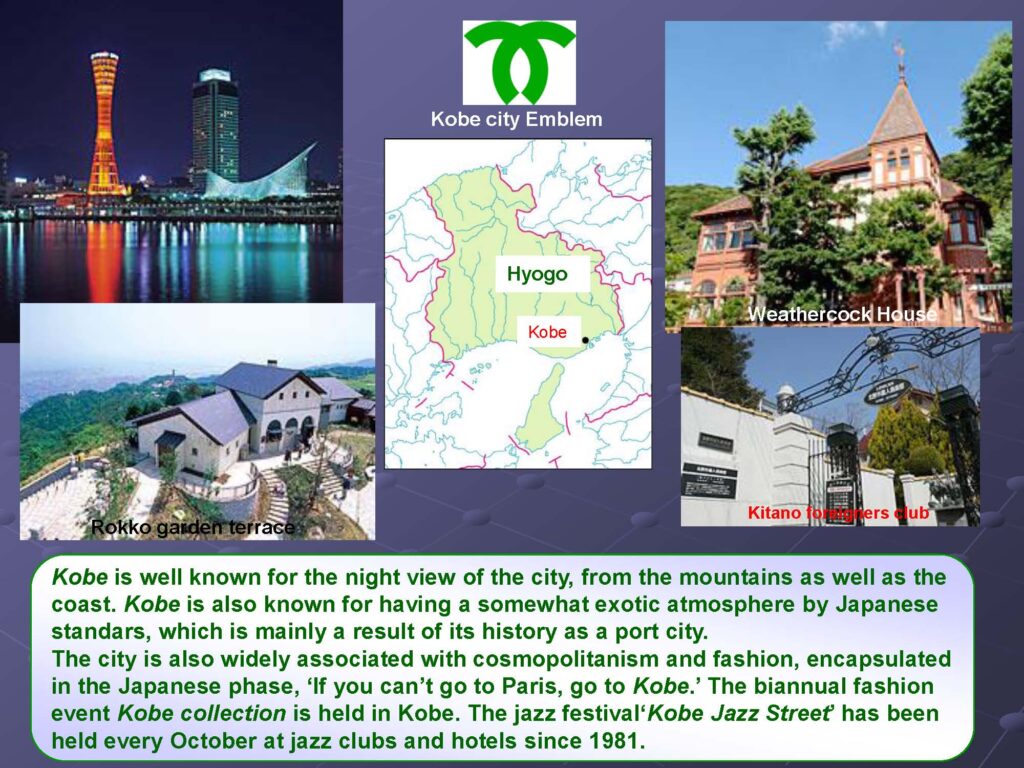
Kobe: A Historic and Modern Port City
Kobe, the capital of Hyōgo Prefecture, is a key city in the Kansai region. Over the centuries, it has grown into one of Japan’s most important port cities, shaping its modern international identity.
1. Historical Significance
- Ancient Roots: Archaeological evidence shows that the Kobe area has been inhabited since prehistoric times.
- Port City Development: During the Nara and Heian periods, Kobe emerged as a major port, facilitating trade and cultural exchange with China and Korea.
- Modernization: In the 19th century, after Japan opened to the world, Kobe became one of the first cities to engage in international trade.
- Great Hanshin Earthquake: In 1995, Kobe was devastated by a 7.3 magnitude earthquake but made a remarkable recovery, rebuilding its infrastructure and economy.
2. Cultural Significance
- International Influence: With a long history of foreign settlement, Kobe blends Japanese and Western influences in its architecture, cuisine, and culture.
- Historic Districts: The city preserves significant historical areas, such as Kitano Ijinkan, known for its Western-style merchant houses, and the former foreign settlement.
- Religious and Cultural Diversity: Kobe is home to various religious sites, including Buddhist temples, Shinto shrines, Christian churches, and Japan’s oldest mosque, Kobe Mosque.
3. Business and Research
- Kobe is a vital part of the Keihanshin metropolitan area, which includes Osaka and Kyoto.
- The city is a major industrial hub, known for its shipbuilding, steel production, and pharmaceuticals.
- Kobe hosts leading companies like Kawasaki Heavy Industries and ASICS.
- It is a center for medical and scientific research, with institutions such as Kobe University and the RIKEN Advanced Institute for Computational Science.
4. Population and Multiculturalism
- With a population of around 1.5 million, Kobe is one of Japan’s largest cities.
- It is part of the Keihanshin Metropolitan Area, which has over 19 million residents.
- Kobe has a vibrant international community, shaped by its long history of foreign trade and cultural diversity.