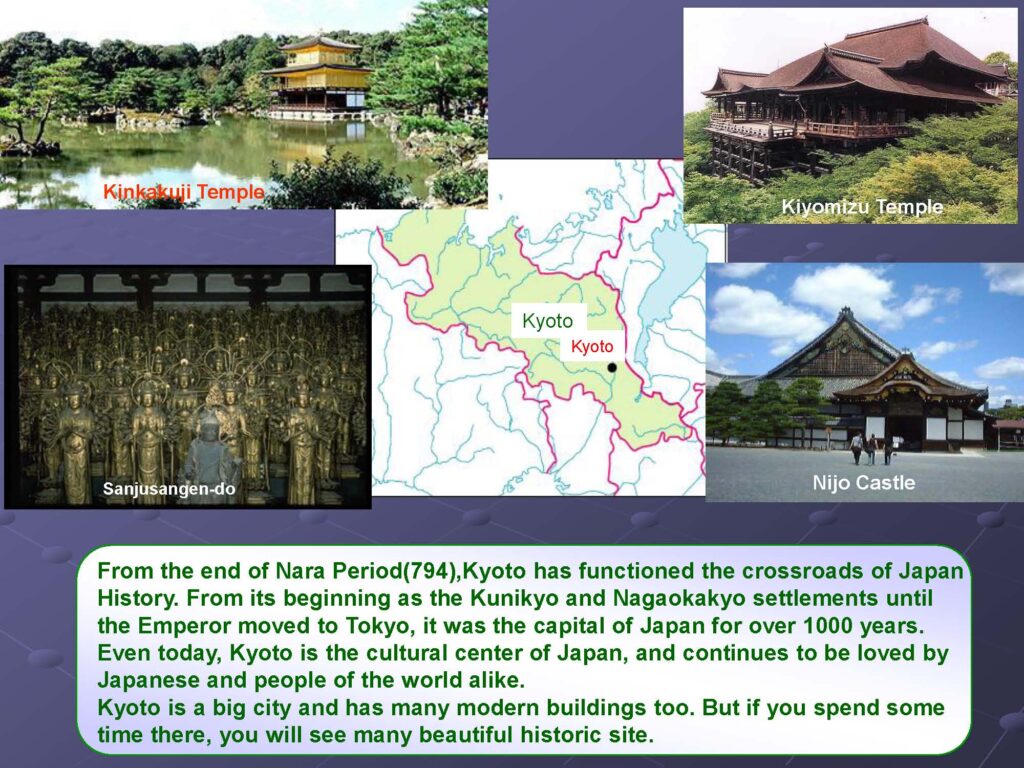
Kyoto, officially known as Kyoto City, is the capital city of Kyoto Prefecture in Japan. Let’s delve into its fascinating history:
- Establishment:
- In 794, Emperor Kanmu chose Kyoto as the new seat of Japan’s imperial court, naming it Heian-kyō. The city was meticulously planned following traditional Chinese feng shui principles, inspired by the ancient Chinese capitals of Chang’an and Luoyang. Kyoto is located in a peaceful valley surrounded by mountains on three sides. North, East and West. The streets are built in a grid pattern running vertically and horizontally.
- For the next eleven centuries, emperors ruled from Kyoto until 1869. Kyoto was the capital of Japan for more than one thousand years. Historically, Kyoto was the largest city in Japan, later surpassed by Osaka and Edo (Tokyo) towards the end of the 16th century.
- Key Historical Events:
- Following a period of wanton destruction in the 15th century, Toyotomi Hideyoshi, ruler of Japan at that period, refashioned Kyoto in the style of the City of Chang’an.
- During the 16thcentury, Toyotomi Hideyoshi doubled up the number of north-south streets. This created the familiar rectangular blocks with shorter side streets that shape the captivating scenery of Kyoto now.
- Meiji Restoration: After the Meiji Restoration, the capital shifted from Kyoto to Tokyo.
- Cultural Significance:
- Preservation: Kyoto was spared from large-scale destruction during World War II, allowing its prewar cultural heritage to be mostly preserved.
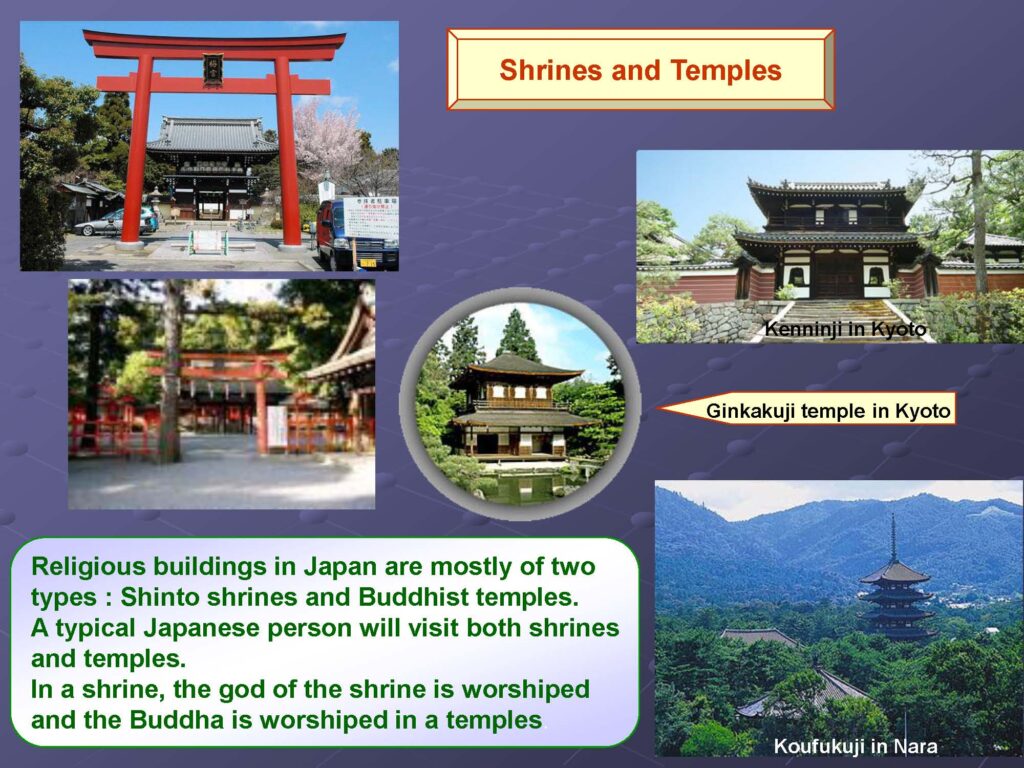
- Cultural Capital: Kyoto is considered the cultural capital of Japan and is home to numerous Buddhist temples(1700), Shinto shrines(800), palaces, and gardens.
- UNESCO World Heritage: Several of these landmarks, including the Kyoto Imperial Palace, Kiyomizu-dera, Kinkaku-ji, Ginkaku-ji, and 17 sites have been collectively designated as a World Heritage Site by UNESCO.
- Population and Modernity:
- As of 2022, Kyoto had a population of 1.4 million, making it the ninth-most populous city in Japan.
- It forms part of the Keihanshin metropolitan area, along with Osaka and Kobe.
- The city’s cultural significance continues to attract tourists and scholars alike.